Blog · Opinion · 26 October 2026
Anthropic's S-1 is a document about agents, and the public won't control Anthropic
Anthropic filed to list on Nasdaq as ANT on 26 October 2026. I read the prospectus and the exhibits with the tool builders in mind, because the whole business described in it is agents calling things. Sales, marketing and partnerships grew faster than compute, mostly as fees to the clouds that resell Claude, and public shareholders will have at most 49.9% of the vote.
 By Vlad Cealicu2,402 words10 min read
The Anthropic S-1 went up on EDGAR at 9am New York time on Monday 26 October 2026, and I spent the afternoon reading it (and getting one of my agents to read the parts the SEC site wouldn't give me in one go, it's 14 MB of HTML). I came out of it thinking it's a document about agents. The glossary alone defines "agent loop", "agentic AI", "multi-agent orchestration", "computer use" and "prompt injection", which I think is the first time a prompt injection has been explained to a securities regulator [1].
If you build tools that agents call, or you run agents that call tools, this filing is the first set of audited numbers on the thing you're standing on.
The business is tokens
Revenue was $41 million in 2023, $386 million in 2024, $4.6 billion in 2025, and $16.3 billion for the first six months of 2026 [1]. The six months a year earlier were $1.2 billion. The filing calls the model "pay-for-intelligence", metered in tokens and priced by the model you pick, and Net Revenue Retention sits at roughly 900% as of 30 September 2026, which is a number I have never seen on any SaaS deck and had to read twice [1].
Revenue
- 202341
- 2024386
- 20254,585
- First half of 202616,286
Bars start at zero. Values are labelled in each panel.
Run-Rate Revenue is consumption fees over the trailing 28 days, times 13, plus monthly subscriptions times 12 [1], so the customers can walk in four weeks and the metric is built to admit it. Put that next to 900% retention and about 40 million customers spending under $100,000 each, and it's a business where most of the money comes from about twelve thousand companies whose agents got busy this year, measured over the last four weeks [1]. I think the definition is honest about that, and it makes the number fragile.
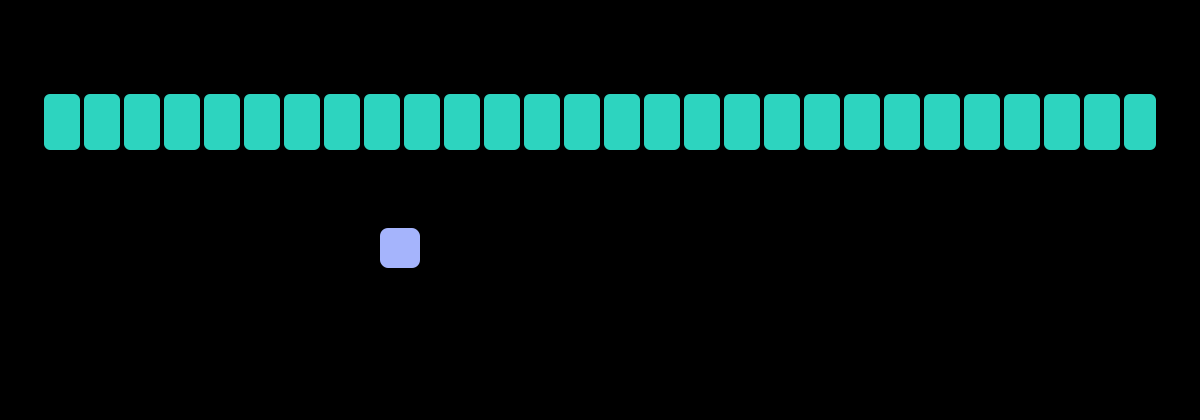
Customer counts as of 30 September 2026 are more than 11,900 organisations spending $100,000 or more a year, more than 1,900 at $1 million or more, and about 250 at $10 million or more [1]. They don't track "enterprise" as a category. The $100k line is the proxy, because an individual doesn't spend that.
Customers
- December 202320
- December 2024200
- December 20251,500
- September 202611,900
Bars start at zero. Values are labelled in each panel.
Who gets paid
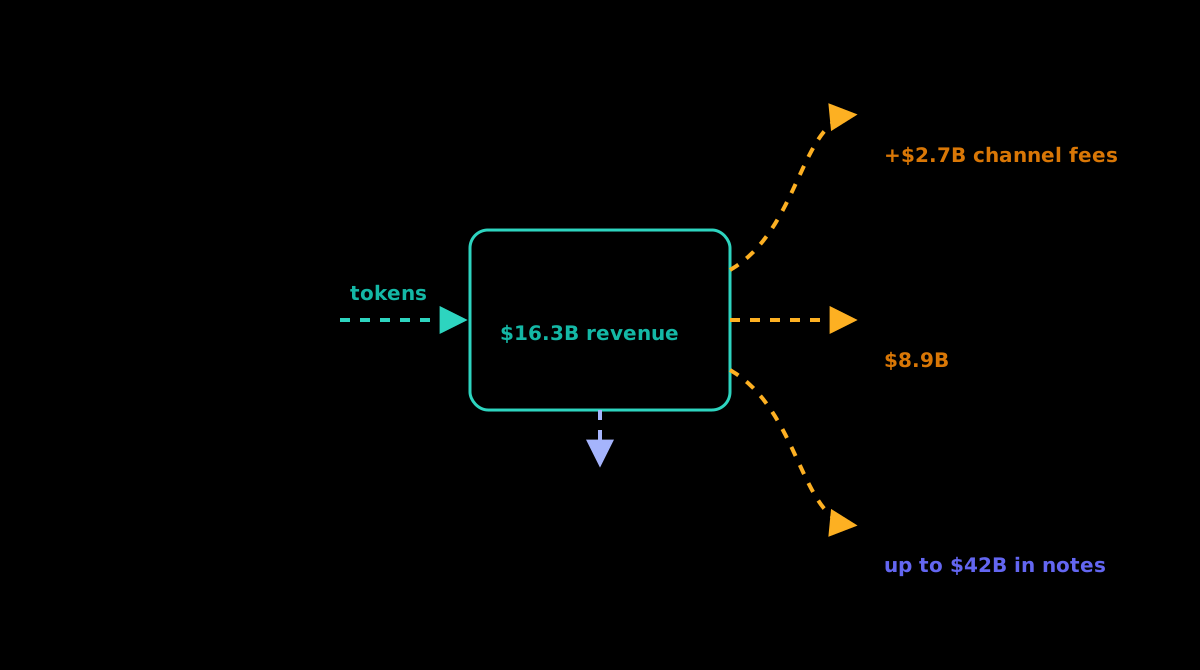
On the cost side, compute and infrastructure was $8.9 billion in the first half of 2026 against $16.3 billion of revenue, and in the second quarter revenue grew 1,368% on the year while compute grew 300% [1]. So each dollar of compute brings in a lot more than it did a year ago. Sales, marketing and partnerships went from $120 million to $3.2 billion in a year, and $2.7 billion of that increase is fees paid to channel partners [1]. That second one surprised me more than the compute. Claude is sold through AWS, Google Cloud and Azure under a joint go-to-market where Anthropic keeps the direct contract, sets the price and pays each cloud a fee [1]. So the clouds earn from Anthropic once for the compute and again on the sales they make, and the sales fees grew faster than any other cost in the accounts.
First half 2025
- Compute and infrastructure2,334
- Sales, marketing and partnerships120
- Personnel538
- Other operating and administrative306
First half 2026
- Compute and infrastructure8,945
- Sales, marketing and partnerships3,168
- Personnel3,152
- Other operating and administrative1,714
Bars start at zero. Values are labelled in each panel. Each panel has its own scale.
The operating loss for the half was $693 million, and the $80.7 billion net loss the headlines are running with is $72.4 billion of change in the fair value of convertible notes, derivatives and SAFEs, mostly Amazon's convertible notes, $6.2 billion of them at face value, going up because the company is worth more [1]. They lost money on paper because they became worth more (accounting is a strange hobby).
The 2025 operating expenses also have a line called "Bartz settlement", $1.5 billion, for the authors' copyright class action over the books the models were trained on, settled in September 2025 and approved by the court in July 2026 [1]. It's the only lawsuit with its own line in the income statement, and the risk factors list more cases still open, from music publishers among others [1].
Where tools come in
The filing's word for what they're building is "Virtual Collaborators", and the description is the part that matters to us. These are agents that carry the access rights, system connections and context their organisation gives them, that navigate internal tools and run multi-step workflows, and the stated aim is millions of them running in parallel, what the document calls a "country of geniuses in a data center" [1].
Each of those system connections is a tool and each workflow step is a call. A usage-based business that charges per token has a direct interest in agents using tools that return clean, short, correct results, because a tool that dumps 40 KB of HTML into the context costs their customer money and makes the model look worse. I've been saying for a while that I don't think MCP is where this ends up (MCP is GraphQL all over again) and that agents want easy APIs with nothing on top. The prospectus doesn't settle that argument, and I think the economics in it point the same way.
Claude Code is named as the clearest example of the pattern, Claude Cowork extends it to non-developers, and the filing says Cowork's adoption after its January 2026 research preview outpaced what Claude Code managed at the same point after February 2025 [1]. In September 2026 they started merging Cowork into Claude.ai. So I think the agent that reads your files and clicks around your desktop is becoming the default surface, and the chat box the thing bolted onto it.
Distribution is the other piece. Besides the three clouds there are Accenture, Deloitte, KPMG and PwC as integrators, Salesforce and Snowflake as data platforms, and a new services company called Ode with Anthropic, built with private equity firms to sell to mid-sized companies [1]. If you sell a tool to agents, those are the channels your tool arrives through, whether you planned it or not.
The landlord
The compute commitment totals in the summary are still blank ("$ ") in this first filing and get filled in with the price range [1], but the exhibits are filled in.
Exhibit 10.11 is a master equipment lease dated 31 March 2026 between Broadcom and a Delaware company called AI Infrastructure OpCo II, LLC, with Anthropic as guarantor [2]. Broadcom buys Google TPU8i hardware (Google appears in the contract under the codename "Enso") and leases it back in pods of racks, five years per pod, twenty equal quarterly instalments, interest at a rate in a separate pricing letter, non-cancelable, and the contract says in plain words that it is intended as a loan rather than a lease for bankruptcy purposes [2].
An "Early Purchase Option Event" fires if certain named people (redacted) stop working full time for Anthropic, or if Anthropic releases one of them to be hired elsewhere, or licenses material IP as part of such a hiring [2]. The chip vendor wrote a key-person trigger into the hardware financing, which I didn't expect. The same contract bans assignment to competitors, foreign governments, and anyone domiciled in China, Russia, Saudi Arabia, Iraq, Afghanistan or Venezuela [2].
The main document also says Anthropic can issue Broadcom, or a financial partner Broadcom picks, up to $42.0 billion of convertible notes [1]. Convertible notes can turn into shares, so the company renting the chips could end up partly owned by the company it rents them from, which is what Amazon's notes allow already.
Exhibit 10.8 is the sublease for 500 Howard Street in San Francisco, 230,208 square feet taken over from Salesforce from January 2024 to August 2028 [3]. Less dramatic, but it's where the people who wrote the glossary sit.
What 2026 could look like
Run-Rate Revenue "as of October 31, 2026" is a "$" and a blank, and so is the price range [1]. The pitch is that its top ten Fortune 500 customers spend less than 1% of their total expenses on Claude, more than eight times the average of its Fortune 500 customers above $100,000, and the story is that everyone else catches up [1].
This arithmetic is mine. If the second half of 2026 only matches the first, with no growth at all, 2026 is $32.6 billion of revenue, about $17.9 billion of compute and about $6.3 billion of sales, marketing and partnerships, most of it fees to channel partners. I don't think the second half will only match the first. I also don't think anything grows 1,300% a year for long, and the filing says the same [1].
First half 2026
- Revenue16,286
- Compute and infrastructure8,945
- Sales, marketing and partnerships3,168
Full year 2026, flat second half
- Revenue32,572
- Compute and infrastructure17,890
- Sales, marketing and partnerships6,336
Bars start at zero. Values are labelled in each panel. Each panel has its own scale.
- JanuaryProduct
Claude Cowork goes out as a research preview [1]
- AprilGated
Mythos is held back as a gated preview through Project Glasswing [1]
- JulyGated
the court approves the $1.5 billion Bartz settlement [1]
- SeptemberProduct
Cowork starts merging into Claude.ai [1]
- 26 OctoberMoney
the S-1 is filed, to list on Nasdaq as ANT [1]
- 31 OctoberStill blank
the date of the Run-Rate Revenue figure the filing leaves blank [1]
- Product
- Money
- Gated
- Still blank
What they say might go wrong
The risk factors run from page 26 to page 120 [1]. A few stood out for anyone depending on the API.
They say they have changed usage limits, rate limits and model capabilities, that some of those changes led to claims that their disclosures were inadequate or misleading, and that it may happen again [1]. If your product sits on top of a model and the limits move, that can be your outage. They also say that considerations of model safety, interpretability, alignment and welfare may lead them to keep older models running longer than they'd like, which costs compute and revenue [1] (welfare, in an SEC risk factor, and I'm not sure what to do with that yet).
They say they have delayed and limited releases before, naming Mythos through Project Glasswing, and that such measures may become more frequent and more costly as capabilities advance [1]. They also admit that their evidence on how fast their own models are accelerating comes from lagging indicators, so they might not notice a jump until after it has happened [1].
Who gets a vote
Five share classes. Class A, the one listing under ANT, gets one vote per share. Class N has no votes and is what the strategic partners hold. Class T is one share held by the Long-Term Benefit Trust and it elects a majority of the board. Class F is one share held by an LLC of the seven co-founders and carries 50.1% of the vote on everything else. Class E goes to employees, votes only on a few limited matters and has no economic rights [1]. The company is a "controlled company" under Nasdaq rules on the strength of that one Class T share.
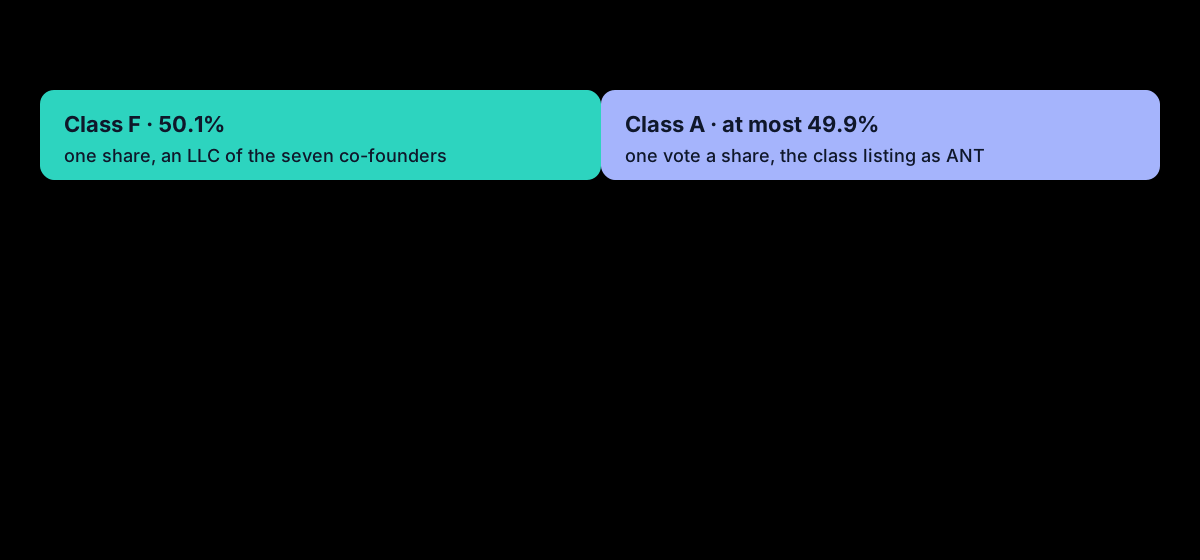
Public shareholders vote on the directors the trust doesn't appoint, with 49.9% of the vote. Whether that's a good structure for the mission is a separate question. For the share price it means you are buying the economics and none of the control, and the filing says so on the cover.
The terms, explained
What is an S-1?
The registration statement a US company files with the SEC before it sells shares to the public for the first time. It has the business, the audited numbers, the risk factors and who controls the company, and later versions add the price range. Anthropic's first one went up on 26 October 2026 with the price and the run-rate left blank.
What does Net Revenue Retention of 900% mean?
It compares what a group of customers pays now with what the same customers paid a year earlier. 900% means they pay about nine times as much, without counting any new customers.
What is Run-Rate Revenue?
Anthropic's own annualised figure, the last 28 days of usage fees times 13 plus the month's subscription fees times 12. It isn't revenue under the accounting rules, and it assumes four weeks of usage carry on for a whole year.
How can a company lose $80.7 billion while selling $16.3 billion?
Most of the loss isn't cash. Amazon's convertible notes, and other instruments, are carried at fair value, and when Anthropic became worth more they became worth more, which goes through the income statement as a $72.4 billion charge. The operating loss, the part from running the business, was $693 million.
What is a convertible note?
A loan that can turn into shares instead of being paid back. Amazon holds $6.2 billion of them at face value, and Broadcom, or a partner it picks, can be issued up to $42 billion more.
What is a "controlled company"?
A Nasdaq term for a listed company where one holder or group controls the board, which lets it skip some independence rules. Anthropic is one because the single Class T share, held by the Long-Term Benefit Trust, elects a majority of the board.
What was Bartz?
Bartz, et al. v. Anthropic, a class action by authors over books the models were trained on. Anthropic settled it for $1.5 billion in September 2025, and the court approved the settlement in July 2026. It's its own line in the 2025 income statement.
Where I stand
I'm a paying customer. The review panel that grades listings on this site runs on Claude, which is why Anthropic's own listings carry a label and a warning, and why I spend part of every month reading their pricing page. So read the above with that in mind. I've tried to keep the opinions to the parts I'd say to their face.
What I'll do with it is the boring thing. The listings for Claude Code, Cowork and the Claude Platform get the numbers from the filing added as evidence, the next issue of The Log covers the price range when the amendment lands, and I'll go through the contractual obligations table properly once it has numbers in it. If you want to read the thing yourself, the main document is 335 pages before the financial statements and the exhibits are where the good bits are [4].
References
Read on 26 and 27 October 2026. Quotes are as published.
- [1]Anthropic, PBC, Form S-1 Registration Statement, filed with the U.S. Securities and Exchange Commission on 26 October 2026. Source for the defined terms, the revenue and expense figures, the compute and channel-partner fee figures, the change in fair value of convertible notes and the Amazon notes, the Bartz settlement, the customer counts, Net Revenue Retention, the Run-Rate Revenue definition, the Virtual Collaborators and Claude Cowork descriptions, the distribution partners, the capital structure and the risk factors quoted. sec.gov
- [2]Broadcom Inc. and AI Infrastructure OpCo II, LLC, Master Equipment Lease Agreement dated 31 March 2026, filed as Exhibit 10.11 to the Anthropic S-1. Source for the TPU8i pod leasing terms, the five-year term and quarterly instalments, the loan characterisation, the Early Purchase Option Event and the assignment restrictions. sec.gov
- [3]Salesforce, Inc. and Anthropic, PBC, Sublease dated 22 September 2023 for 500 Howard Street, San Francisco, filed as Exhibit 10.8 to the Anthropic S-1. Source for the square footage and term. sec.gov
- [4]U.S. Securities and Exchange Commission, EDGAR filing index for accession number 0001628280-26-067168, Anthropic, PBC. The directory listing of every document in the filing. sec.gov